
Operational Interoperability
for AI-Supported Product Systems
“Design systems increasingly stabilize the shared operational structures through which humans, organizations, runtime systems and AI systems participate in product logic.”
Shared Operational Structures
How human-relevant states become understandable, interoperable and governable across humans, runtime systems and AI-supported product systems.
Operational interoperability emerges when humans, organizations, runtime systems and AI systems participate through the same shared operational semantics. Integrity Architecture describes how those shared operational structures are stabilized across semantic, technical, organizational and AI-supported product systems. AI is therefore not treated as an isolated technology layer. It increasingly participates in the same operational structures already shared by humans, runtime systems and organizations. As AI participation grows, those structures increasingly need to remain human-readable, runtime-executable, machine-readable, agent-operable and governable.
“I design shared product structures that enable distributed teams, enterprise platforms and AI-supported development to evolve without losing product coherence.”
Fragmentation Zones
As product systems grow across domains, teams, technologies and regulatory contexts, fragmentation ceases to be an isolated inconvenience and becomes a systemic source of product, governance and compliance risk.
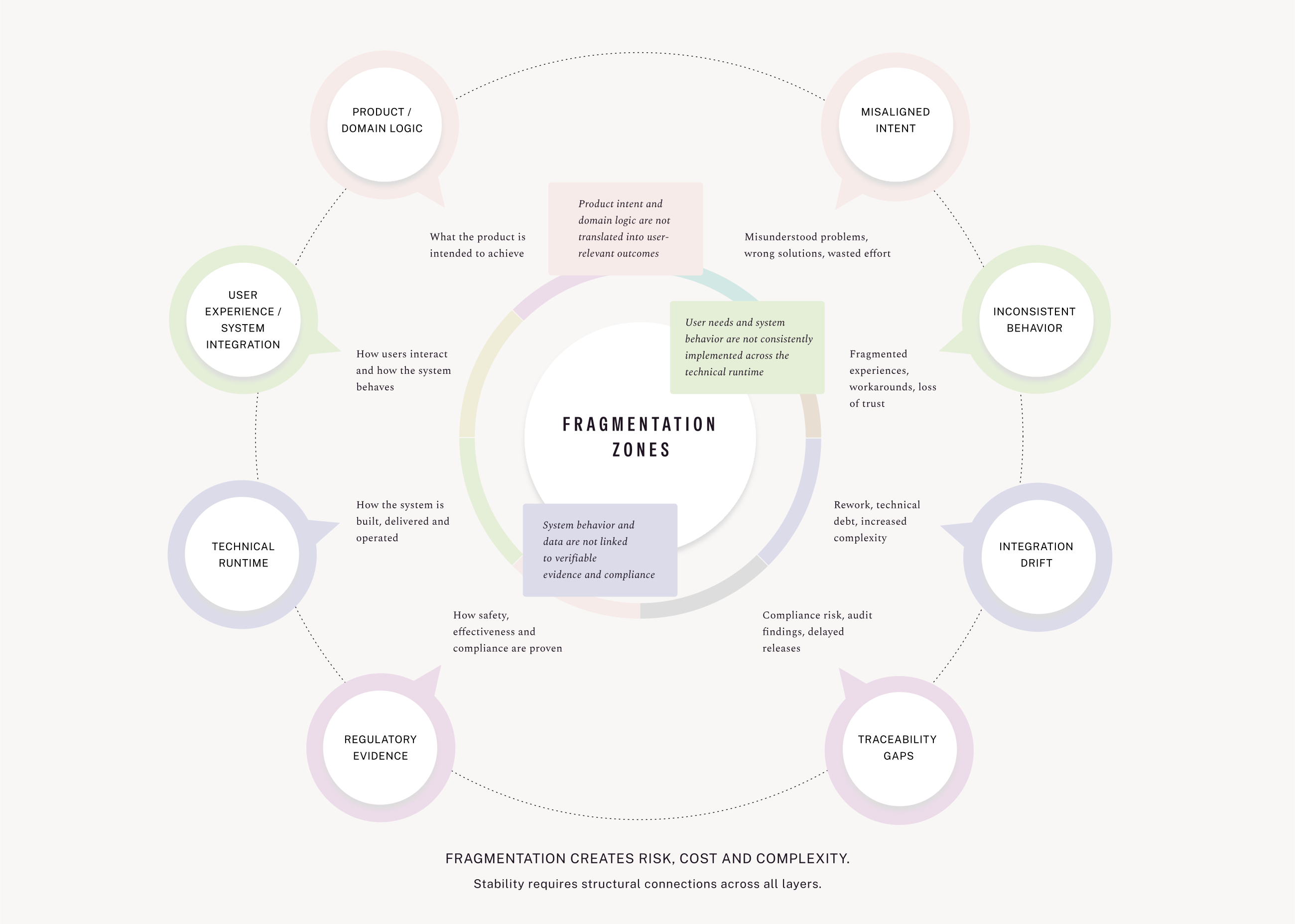
Read diagram as text: Fragmentation Zones
Four layers of a product system are arranged in a ring around the centre, “Fragmentation zones”. Each layer is paired with the fragmentation that occurs when it is not structurally connected to the others, and with its consequences.
- Product / domain logic – what the product is intended to achieve. Fragmentation: misaligned intent, leading to misunderstood problems, wrong solutions and wasted effort.
- User experience / system integration – how users interact and how the system behaves. Fragmentation: inconsistent behavior, leading to fragmented experiences, workarounds and loss of trust.
- Technical runtime – how the system is built, delivered and operated. Fragmentation: integration drift, leading to rework, technical debt and increased complexity.
- Regulatory evidence – how safety, effectiveness and compliance are proven. Fragmentation: traceability gaps, leading to compliance risk, audit findings and delayed releases.
At the centre, three gaps connect the zones: product intent and domain logic are not translated into user-relevant outcomes; user needs and system behavior are not consistently implemented across the technical runtime; system behavior and data are not linked to verifiable evidence and compliance.
Conclusion: fragmentation creates risk, cost and complexity. Stability requires structural connections across all layers.
Digital product systems rarely break because of individual components. Structural risk emerges when the relationships between product intent, human use, technical implementation and regulatory evidence are not coherently connected. As these relationships fragment, product systems increasingly drift across teams, runtime implementations and governance structures.
Cost of Misalignment
- Fragmentation creates risk, cost and complexity.
- Systems drift across runtime, governance and organizational boundaries.
- AI amplifies architectural inconsistency without shared operational structures.
- Product systems fail when operational relationships fragment.
“Product systems fail where critical relationships remain unstabilized.”
System Integrity in Practice
As product systems become increasingly distributed across domains, organizations, runtime environments and AI-supported workflows, the critical architectural challenge is no longer component consistency but operational coherence. System integrity emerges from explicit shared structures that preserve one operational logic across requirements, semantic contracts, runtime behavior, feedback loops and human decision making, enabling complex product systems to remain governable, interoperable and scalable while reducing structural product and governance risk.
- Design Systems as Infrastructure
- Shared Operational Logic
- Semantic Contracts
- Cross-Domain Behavioral Integrity
- AI Governance Architecture
- Decision Integrity
Who This Is For
Relevant for organizations operating in complex product environments where product intent, human use, technical implementation and regulatory requirements must remain structurally aligned.
- Executive Management
- Product Leaders
- Engineering Leaders
- Design Leaders
- Quality & Regulatory Teams
Integrity Architecture
How system integrity emerges through interoperable artifacts.
Design Systems as Infrastructure
Why design systems are enterprise infrastructure.
Publications
Articles on product systems, use cases and system architecture.
As AI accelerates product exploration, structural integrity becomes the critical design challenge.
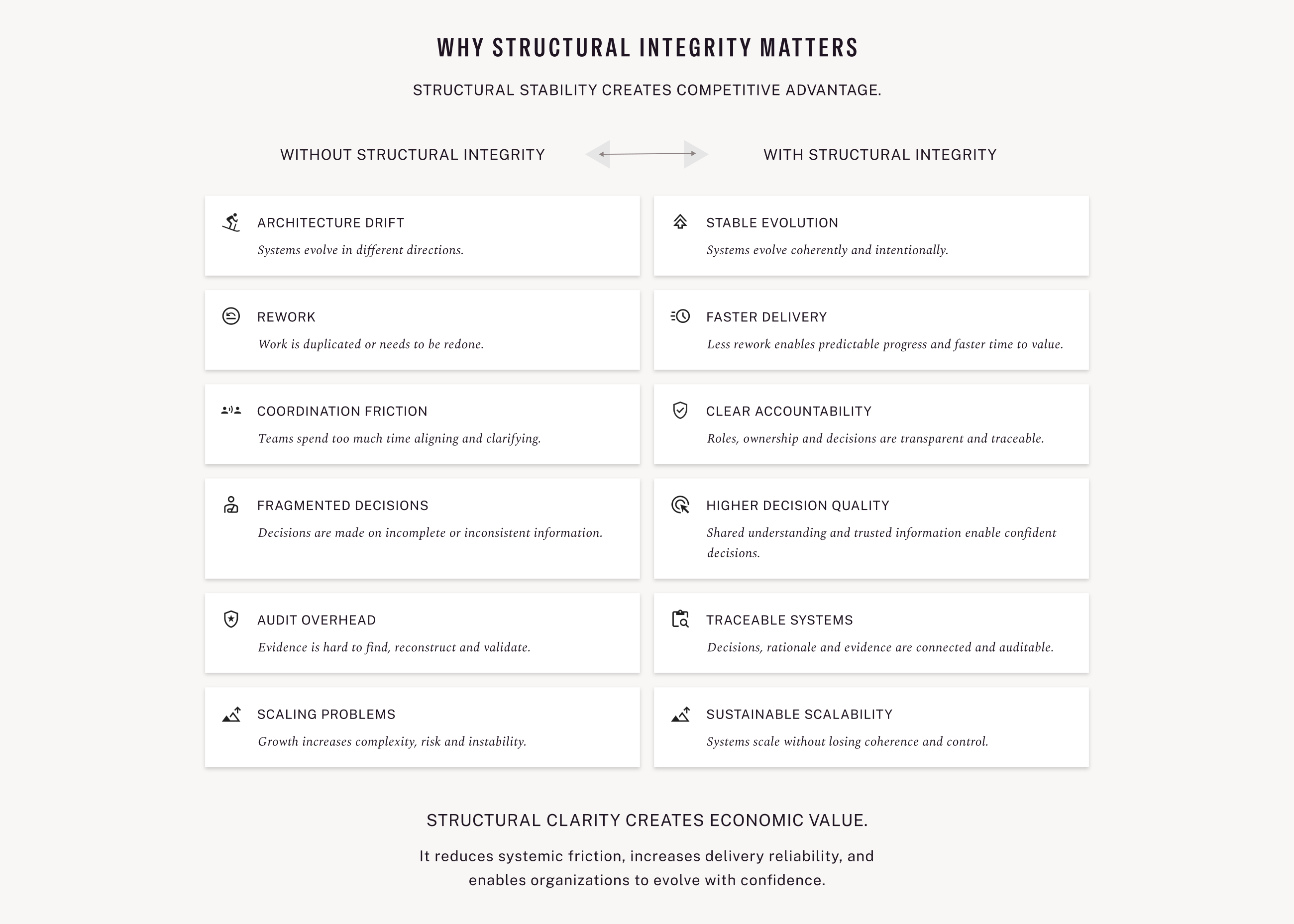
Read diagram as text: Why Structural Integrity Matters
Structural stability creates competitive advantage. Six problems without structural integrity are each set against their counterpart with structural integrity:
- Architecture drift (systems evolve in different directions) becomes stable evolution (systems evolve coherently and intentionally).
- Rework (work is duplicated or needs to be redone) becomes faster delivery (less rework enables predictable progress and faster time to value).
- Coordination friction (teams spend too much time aligning and clarifying) becomes clear accountability (roles, ownership and decisions are transparent and traceable).
- Fragmented decisions (decisions are made on incomplete or inconsistent information) become higher decision quality (shared understanding and trusted information enable confident decisions).
- Audit overhead (evidence is hard to find, reconstruct and validate) becomes traceable systems (decisions, rationale and evidence are connected and auditable).
- Scaling problems (growth increases complexity, risk and instability) become sustainable scalability (systems scale without losing coherence and control).
Conclusion: structural clarity creates economic value. It reduces systemic friction, increases delivery reliability, and enables organizations to evolve with confidence.
“Organizations increasingly compete through their ability to evolve shared operational structures faster than organizational complexity grows.”