Design Systems as Infrastructure
Why design systems are enterprise infrastructure.
A design system is not a component library. In AI-era product systems, design systems increasingly evolve into the shared operational foundation through which humans, runtime systems and AI systems participate in the same product logic.
“Design systems do not primarily solve reuse. They stabilize the relationships that determine system integrity.”
Fragmentation is the default
Digital product systems do not evolve as coherent wholes. They grow across domains, teams, releases and technologies. Without structural stabilization, fragmentation becomes the default.
Typical Symptoms
- Misaligned intent
- Inconsistent behavior
- Integration drift
- Evidence gaps
- Diffused accountability
The Six Infrastructure Dimensions
The System Integrity Evolution Model describes how product intent is transformed into operational and auditable system structures. The Six Infrastructure Dimensions describe the business capabilities a design system must stabilize to make this transformation scalable.

“The six dimensions no longer stabilize isolated interfaces alone. Together, they stabilize the shared operational foundation through which modern product systems evolve.”
From use cases to runtime
A design system becomes infrastructure when it stabilizes the relationships between human-relevant product states across meaning, semantics, runtime, governance and regulatory evidence. Semantic contracts translate human-relevant states into shared operational semantics.
Use cases define which states matter.
Use cases define the states that matter. They make visible which states in a product system are relevant to users and therefore must be stabilized consistently across domains.
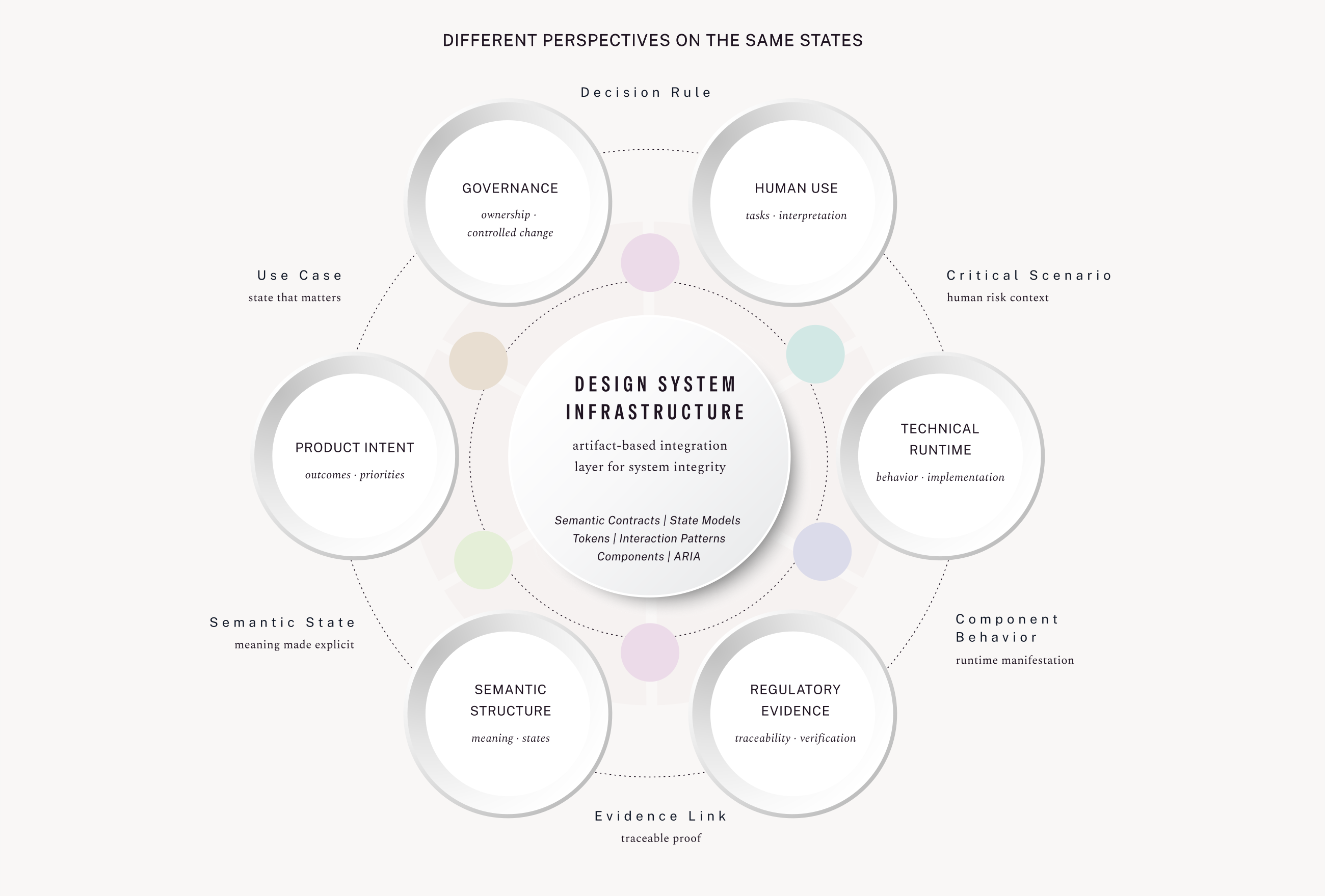
Read diagram as text: Different Perspectives on the Same States
At the centre is the design system infrastructure: an artifact-based integration layer for system integrity, made of semantic contracts, state models, tokens, interaction patterns, components and ARIA.
Six perspectives on the same states surround it in a ring. Each perspective is connected to the next by a shared element, read clockwise from the top left:
- Governance (ownership, controlled change) connects to human use through the decision rule.
- Human use (tasks, interpretation) connects to technical runtime through the critical scenario: the human risk context.
- Technical runtime (behavior, implementation) connects to regulatory evidence through component behavior: the runtime manifestation.
- Regulatory evidence (traceability, verification) connects to semantic structure through the evidence link: traceable proof.
- Semantic structure (meaning, states) connects to product intent through the semantic state: meaning made explicit.
- Product intent (outcomes, priorities) connects back to governance through the use case: the state that matters.
The Dots That Matter
System integrity does not emerge at a single point in time. It evolves as critical interfaces between product-system layers are repeatedly stabilized through interoperable contracts, artifacts and governance structures.

The states that matter to humans are the same states that must be structurally stabilized.
Human-Relevant Product Systems
Products exist because they influence human decisions. The states that matter to humans become the structural reference points. Architecture is the discipline that keeps those states coherent across humans, organizations, runtime systems and AI.
Why Most Design Systems Fail
Most design systems fail because they focus on components rather than on the relationships those components are meant to stabilize.
- No shared semantics
- No governance
- No ownership
- No versioned contracts
- No regulatory integration
- No economic framing
“A design system is not a component library. It is infrastructure for system integrity.”
Shared Operational Logic
The Shared Operational Logic illustrates how humans, organizations, runtime systems and AI systems participate through the same operational semantics. It positions design systems as the infrastructure that stabilizes this shared foundation, enabling interoperable participation, accountable decisions and coherent product evolution.
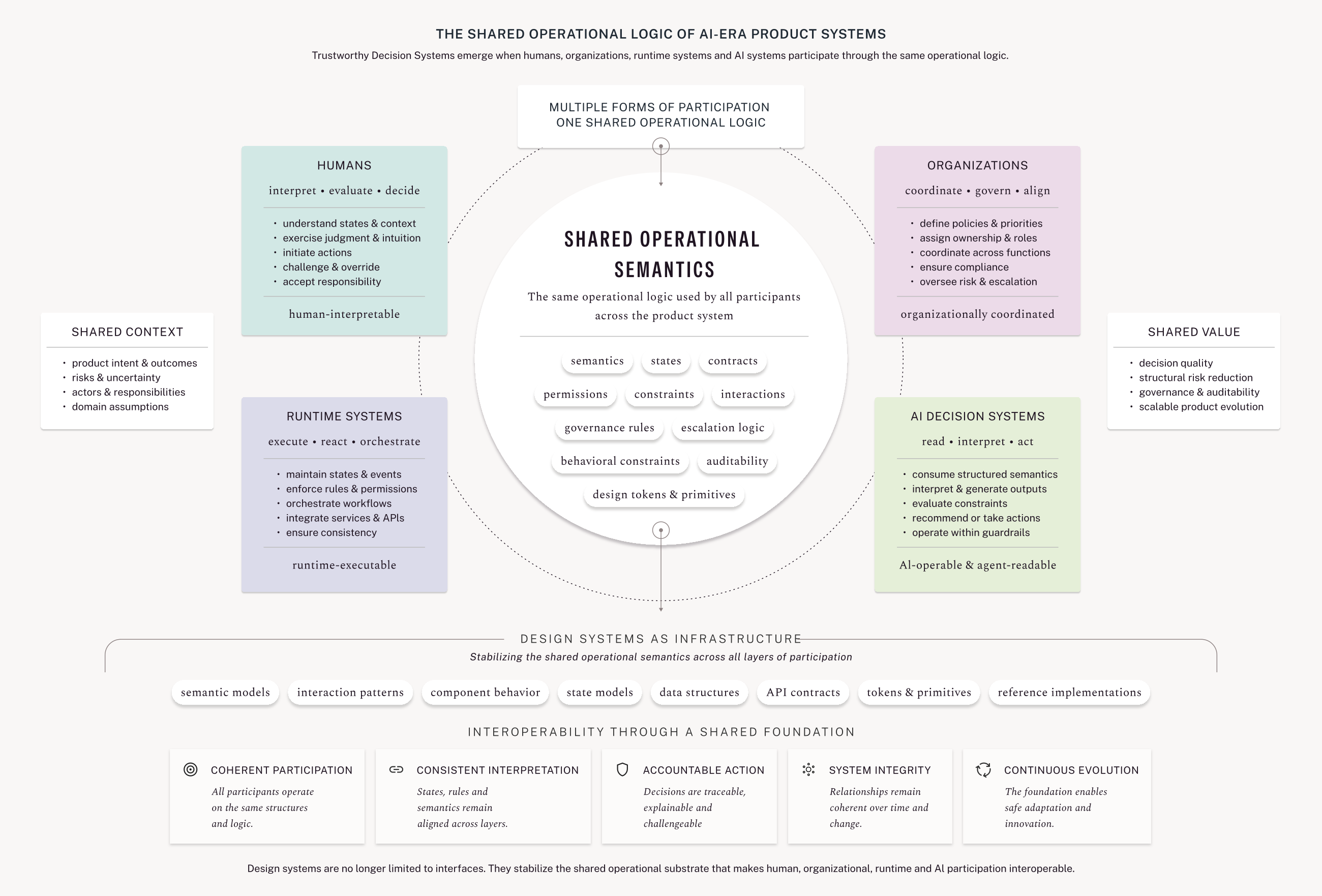
Read diagram as text: The Shared Operational Logic of AI-Era Product Systems
Trustworthy decision systems emerge when humans, organizations, runtime systems and AI systems participate through the same operational logic: multiple forms of participation, one shared operational logic.
Four participants surround the centre:
- Humans interpret, evaluate and decide: they understand states and context, exercise judgment and intuition, initiate actions, challenge and override, and accept responsibility. Their participation is human-interpretable.
- Organizations coordinate, govern and align: they define policies and priorities, assign ownership and roles, coordinate across functions, ensure compliance, and oversee risk and escalation. Their participation is organizationally coordinated.
- Runtime systems execute, react and orchestrate: they maintain states and events, enforce rules and permissions, orchestrate workflows, integrate services and APIs, and ensure consistency. Their participation is runtime-executable.
- AI decision systems read, interpret and act: they consume structured semantics, interpret and generate outputs, evaluate constraints, recommend or take actions, and operate within guardrails. Their participation is AI-operable and agent-readable.
At the centre are the shared operational semantics, the same operational logic used by all participants across the product system: semantics, states, contracts, permissions, constraints, interactions, governance rules, escalation logic, behavioral constraints, auditability, design tokens and primitives.
On the left, the shared context flows in: product intent and outcomes, risks and uncertainty, actors and responsibilities, domain assumptions. On the right, the shared value results: decision quality, structural risk reduction, governance and auditability, scalable product evolution.
Below, design systems as infrastructure stabilize the shared operational semantics across all layers of participation through semantic models, interaction patterns, component behavior, state models, data structures, API contracts, tokens and primitives, and reference implementations.
This creates interoperability through a shared foundation:
- Coherent participation: all participants operate on the same structures and logic.
- Consistent interpretation: states, rules and semantics remain aligned across layers.
- Accountable action: decisions are traceable, explainable and challengeable.
- System integrity: relationships remain coherent over time and change.
- Continuous evolution: the foundation enables safe adaptation and innovation.
Conclusion: design systems are no longer limited to interfaces. They stabilize the shared operational substrate that makes human, organizational, runtime and AI participation interoperable.
The states that matter to humans increasingly become the same states that must remain structurally interpretable across runtime systems, governance structures and AI-supported environments.
Design systems stabilize these shared operational structures through semantics, behavior, governance and traceability.