Integrity Architecture
How system integrity emerges through interoperable artifacts.
In complex product systems, structural risk does not primarily arise within individual disciplines. It emerges where relationships between product intent, human use, technical implementation and regulatory evidence are not sufficiently stabilized.
Integrity Architecture explains how interoperable artifacts transform these relationships into coherent, scalable and auditable system structures, enabling shared operational structures that remain understandable, governable and interoperable across human, technical and organizational participation.
“As AI increasingly participates in operational product systems, architecture expands beyond technical implementation toward the operational integrity of the product system itself.”
Structural Problem Landscape
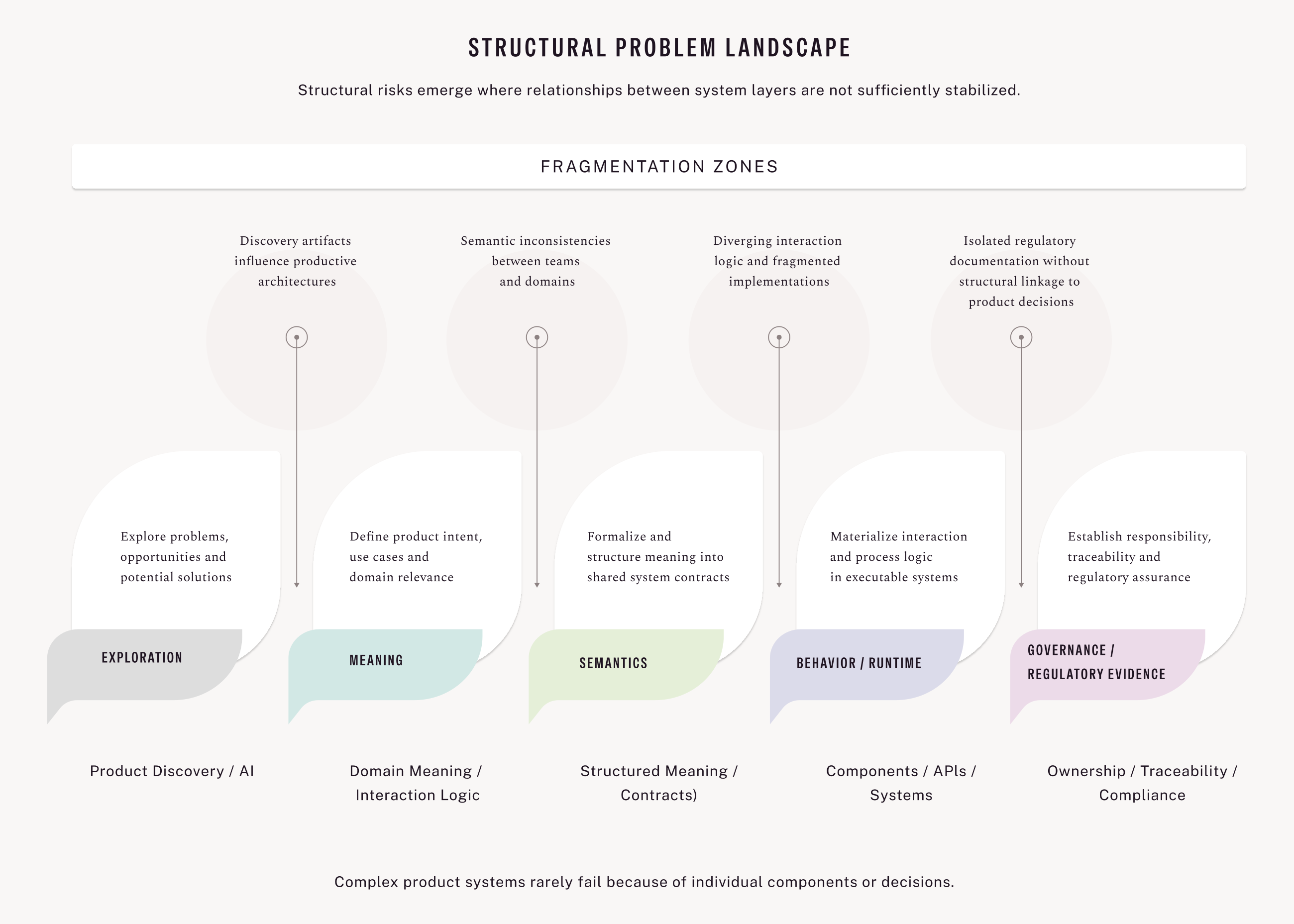
Complex product systems evolve across multiple interdependent layers. Fragmentation at critical interfaces leads to misaligned intent, inconsistent behavior, integration drift and evidence gaps.
Read diagram as text: Structural Problem Landscape
Structural risks emerge where relationships between system layers are not sufficiently stabilized. Five layers follow each other from left to right:
- Exploration (product discovery / AI): explore problems, opportunities and potential solutions.
- Meaning (domain meaning / interaction logic): define product intent, use cases and domain relevance.
- Semantics (structured meaning / contracts): formalize and structure meaning into shared system contracts.
- Behavior / runtime (components / APIs / systems): materialize interaction and process logic in executable systems.
- Governance / regulatory evidence (ownership / traceability / compliance): establish responsibility, traceability and regulatory assurance.
Fragmentation zones lie at the four interfaces between neighbouring layers:
- Exploration to meaning: discovery artifacts influence productive architectures.
- Meaning to semantics: semantic inconsistencies between teams and domains.
- Semantics to behavior / runtime: diverging interaction logic and fragmented implementations.
- Behavior / runtime to governance: isolated regulatory documentation without structural linkage to product decisions.
Conclusion: complex product systems rarely fail because of individual components or decisions.
System Integrity Evolution Model
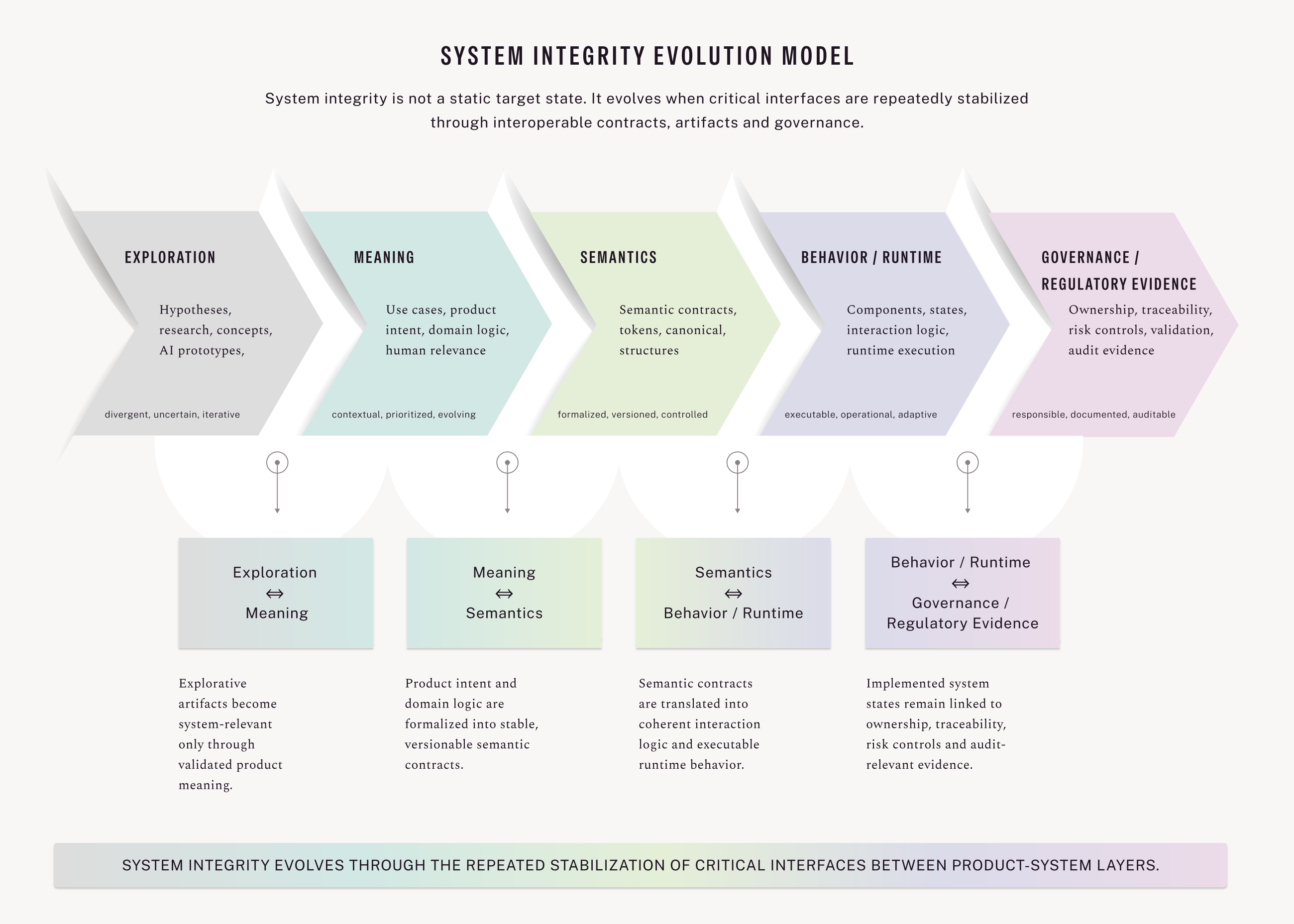
System integrity does not emerge at a single point in time. It evolves as critical interfaces between product-system layers are repeatedly stabilized through interoperable contracts, artifacts and governance structures.
Read diagram as text: System Integrity Evolution Model
System integrity is not a static target state. It evolves when critical interfaces are repeatedly stabilized through interoperable contracts, artifacts and governance. Five stages follow each other from left to right:
- Exploration: hypotheses, research, concepts, AI prototypes. Divergent, uncertain, iterative.
- Meaning: use cases, product intent, domain logic, human relevance. Contextual, prioritized, evolving.
- Semantics: semantic contracts, tokens, canonical structures. Formalized, versioned, controlled.
- Behavior / runtime: components, states, interaction logic, runtime execution. Executable, operational, adaptive.
- Governance / regulatory evidence: ownership, traceability, risk controls, validation, audit evidence. Responsible, documented, auditable.
Four critical interfaces connect neighbouring stages:
- Exploration and meaning: explorative artifacts become system-relevant only through validated product meaning.
- Meaning and semantics: product intent and domain logic are formalized into stable, versionable semantic contracts.
- Semantics and behavior / runtime: semantic contracts are translated into coherent interaction logic and executable runtime behavior.
- Behavior / runtime and governance / regulatory evidence: implemented system states remain linked to ownership, traceability, risk controls and audit-relevant evidence.
Conclusion: system integrity evolves through the repeated stabilization of critical interfaces between product-system layers.
AI does not introduce a separate operational layer. It increasingly participates in the same operational structures already used by humans, organizations and runtime systems. As a result, product systems increasingly depend on shared operational structures that remain understandable, governable and interoperable across human and machine participation.
“System integrity is an emergent property of stabilized relationships.”
From States to System Integrity
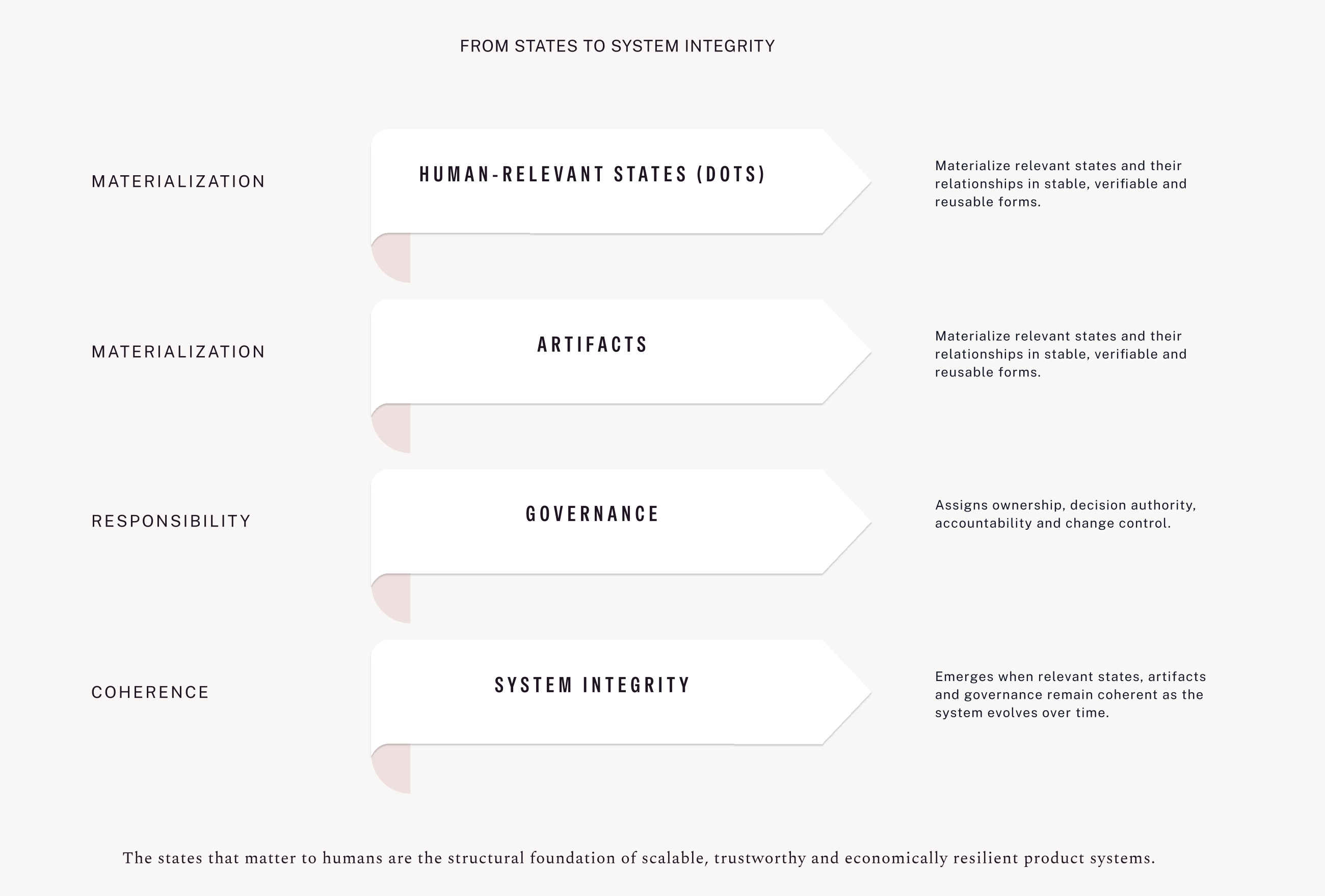
A coherent product system can be understood through four conceptual layers.
- States define what matters.
- Artifacts stabilize what matters.
- Governance assigns responsibility.
- System integrity emerges.
Read diagram as text: From States to System Integrity
Four levels build on each other from top to bottom. Each is named on the left by its role and explained on the right:
- Human-relevant states (dots) – materialization.
- Artifacts – materialization: they materialize relevant states and their relationships in stable, verifiable and reusable forms.
- Governance – responsibility: it assigns ownership, decision authority, accountability and change control.
- System integrity – coherence: it emerges when relevant states, artifacts and governance remain coherent as the system evolves over time.
Conclusion: the states that matter to humans are the structural foundation of scalable, trustworthy and economically resilient product systems.
System Integrity Framework
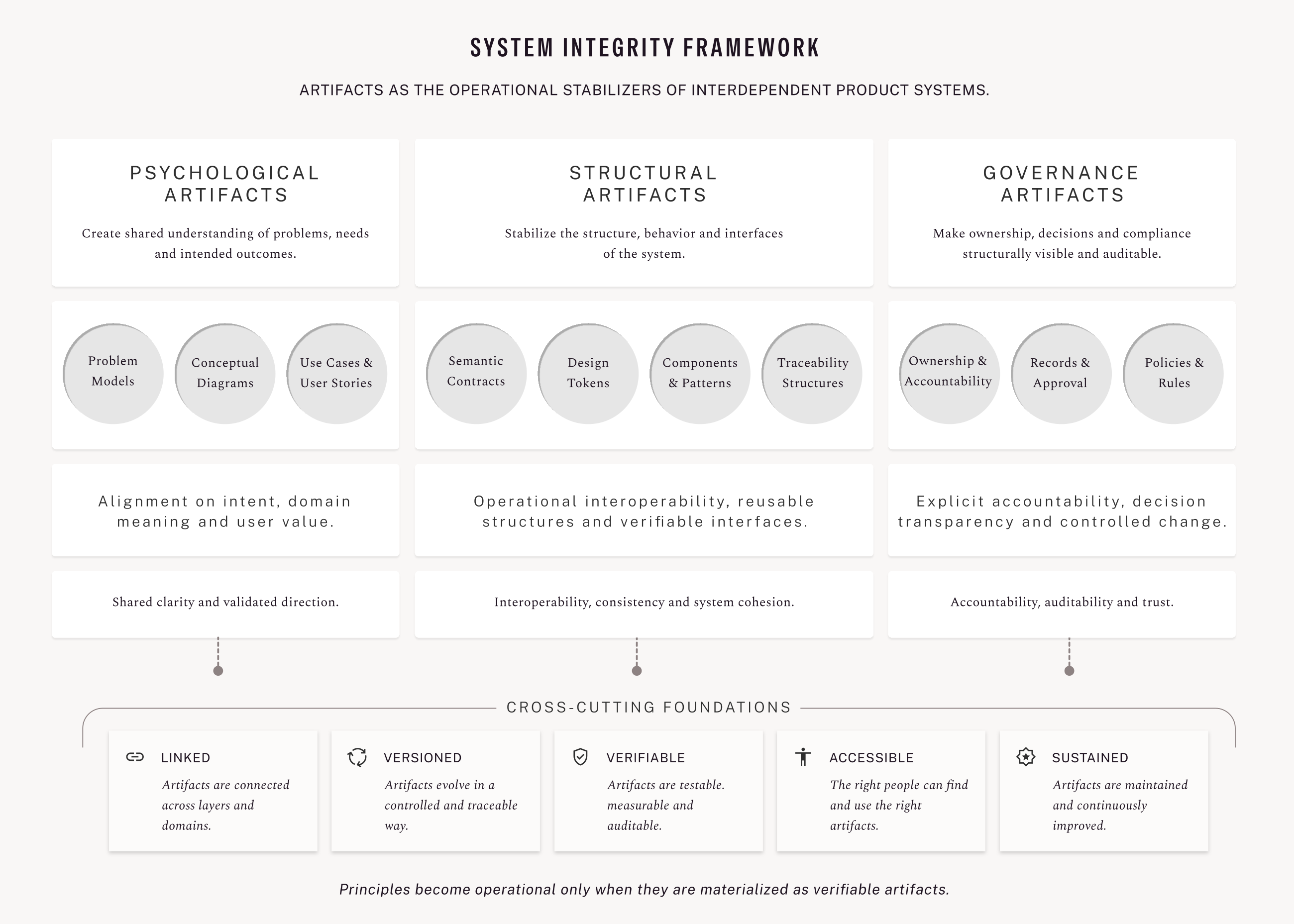
Artifacts are the operational stabilizers of interdependent product systems. Principles and intentions remain interpretive, and structural clarity becomes organizational value, only when decisions are materialized as verifiable artifacts. The System Integrity Framework distinguishes three artifact classes that stabilize shared understanding, structural interoperability and organizational accountability, reducing structural risk and enabling scalable execution.
Read diagram as text: System Integrity Framework
Artifacts are the operational stabilizers of interdependent product systems. The framework has three columns of artifacts, each read from top to bottom: purpose, examples, what it enables, and the result.
- Psychological artifacts create shared understanding of problems, needs and intended outcomes. Examples: problem models, conceptual diagrams, use cases and user stories. They enable alignment on intent, domain meaning and user value. Result: shared clarity and validated direction.
- Structural artifacts stabilize the structure, behavior and interfaces of the system. Examples: semantic contracts, design tokens, components and patterns, traceability structures. They enable operational interoperability, reusable structures and verifiable interfaces. Result: interoperability, consistency and system cohesion.
- Governance artifacts make ownership, decisions and compliance structurally visible and auditable. Examples: ownership and accountability, records and approval, policies and rules. They enable explicit accountability, decision transparency and controlled change. Result: accountability, auditability and trust.
All three columns rest on five cross-cutting foundations:
- Linked: artifacts are connected across layers and domains.
- Versioned: artifacts evolve in a controlled and traceable way.
- Verifiable: artifacts are testable, measurable and auditable.
- Accessible: the right people can find and use the right artifacts.
- Sustained: artifacts are maintained and continuously improved.
Conclusion: principles become operational only when they are materialized as verifiable artifacts.
“The same operational artifacts increasingly coordinate human decisions, runtime systems, organizational governance and AI-supported workflows simultaneously.”
Economic Impact
Structural clarity creates measurable business value by reducing systemic friction and increasing delivery reliability.
- Reduced structural risk
- Higher decision quality
- Improved auditability
- Sustainable scalability
“Integrity architecture transforms structural clarity into organizational and economic advantage.”
Architecture Paper
An operating model for understanding how system integrity emerges through artifacts, governance and interoperable product-system structures.
- 1.1 Product Systems as Socio-Technical Systems
- 1.2 Structural Fragmentation in Complex SaaS Systems
- 2.0 Operating Model for System Integrity
- 2.1 System Integrity Evolution Model
- 2.2 From Principles to Artifacts
- 2.3 System Integrity Framework
- 2.4 Economic Impact of Structural Integrity
- 2.5 Institutionalizing Integrity Architecture
- 2.6 Methodological Integrability of Integrity Architecture
Available upon request for qualified conversations.
“Product systems become stable when the same operational logic remains interpretable, executable, governable and accountable across all participants and system layers.”